 Cell Cycle and Cell Division - Live Session Contact Number: 8527521718Cell Cycle and Cell Division - Live Session Contact Number: 8527521718
The sequence of events by which cells duplicate their genome, synthesize the other components of cell which eventually distribute into two daughter cells is called
| 1. | Quiescent stage | 2. | Generation time |
| 3. | Cell cycle | 4. | Kinetochore |
A biosynthetic phase where cell organelle duplicate itself is
| 1. | Interphase | 2. | Anaphase |
| 3. | Prophase | 4. | Telophase |
Yeast can progress through the cell cycle in about
| 1. | 90 sec | 2. | 90 min |
| 3. | 90 hrs | 4. | 90 yrs |
Interphase is called the resting phase because
| 1. | It is the most active phase of the cell cycle |
| 2. | It does not involve any activity related to cell division |
| 3. | It does not prepare cell for cell division |
| 4. | It is the phase where cell rests before entering into mitosis |
If the initial amount of DNA is 8 C, then after S phase the amount of DNA would be
| 1. | 4 C | 2. | 8 C |
| 3. | 64 C | 4. | 16 C |
The number of chromosomes in G1 phase is 36, the number of chromosomes in S phase is
| 1. | 36 | 2. | 18 |
| 3. | 22 | 4. | 37 |
Most dramatic period of cell cycle is
| 1. | G1 phase |
| 2. | G2 phase |
| 3. | S phase |
| 4. | M phase |
Which type of cell division is called somatic cell division?
| 1. | Meiosis I |
| 2. | Meiosis II |
| 3. | Reduction division |
| 4. | Mitosis |
Nucleolus and nuclear membrane disappear during
| 1. | Anaphase | 2. | Interphase |
| 3. | Telophase | 4. | Prophase |
Read the following statements
| (a) | Complete disintegration of the nuclear envelope marks the start of the second phase of mitosis. |
| (b) | Metaphase chromosome is made up of one sister chromatid. |
| 1. | Only (b) is correct |
| 2. | Both (a) & (b) are incorrect |
| 3. | Only (a) is correct |
| 4. | Both (a) & (b) are correct |
The point of attachment of microtubules on the chromosome is called as
| 1. | Centromere | 2. | Kinetochore |
| 3. | Chromatid | 4. | Spindle |
If karyokinesis is not followed by cytokinesis, then gives rise to
| 1. | Zygote |
| 2. | Fertilised egg |
| 3. | Multinucleate condition |
| 4. | Embryo |
In pachytene, each tetrad contains
| 1. | Two chromatids |
| 2. | One chromatid |
| 3. | Four chromatids |
| 4. | Three chromatids |
_________ marks the site where crossing over had occurred.
| 1. | Diakinesis | 2. | Synapsis |
| 3. | Chiasmata | 4. | Leptotene |
Major check point of cell cycle is
| 1. | G1 S transition |
| 2. | S G1 transition |
| 3. | G2 M transition |
| 4. | M G2 transition |
What will be the amount of DNA in meiosis II products if meiocyte contains 30 Pg DNA in G1 phase?
| 1. | 30 Pg | 2. | 60 Pg |
| 3. | 15 Pg | 4. | 120 Pg |
Select an incorrect statement with respect to cell cycle
| 1. | Duplication of genes occurs twice in meiosis |
| 2. | Karyokinesis occurs twice during meiotic division |
| 3. | Cyclins are proteins that activate protein kinases to regulate the cell cycle |
| 4. | After telophase-I, chromosome number is reduced to half. |
Cyclin Dependent Kinases (CDKs)
| 1. | Act as mitotic poisons |
| 2. | Cause disassembly of the microtubules |
| 3. | Control various phases of cell cycle |
| 4. | Arrest cell division due to non-formation of spindle |
Higher plants differ from animals in having
| 1. | Spindle microtubule |
| 2. | Anastral mitosis |
| 3. | Kinetochores |
| 4. | Disappearance of nucleolus during prophase |
Which of the following phases are longest and shortest in mitosis?
| 1. | Metaphase, Anaphase |
| 2. | Prophase, Anaphase |
| 3. | Telophase, Anaphase |
| 4. | Prophase, Telophase |
How many generations are required by a cell of meristem to produce 128 cells?
| 1. | 127 | 2. | 64 |
| 3. | 32 | 4. | 7 |
Phragmoplast is formed by golgi complex and grows
| 1. | Centripetally to form cell plate |
| 2. | Centrifugally to form cell plate |
| 3. | Centripetally to produce a cleavage furrow |
| 4. | Centrifugally to form a cleavage furrow |
Cytokinesis in a plant cell is achieved by the formation of cell plate instead of a cleavage furrow, which is formed in
| 1. | Centripetal manner |
| 2. | Centrifugal manner |
| 3. | Both centripetal and centrifugal manner |
| 4. | Equational manne |
All are the essential stages that take place during meiosis, except
| 1. | Two successive divisions without any DNA replication occuring between them |
| 2. | Formation of chiasmata and crossing over |
| 3. | Segregation of homologous chromosomes |
| 4. | Number of chromosomes in daughter cells after meiosis II is reduced to half but the amount of DNA remains the same |
To produce 102 pollen grains, how many meiotic divisions are required?
| 1. | 25 | 2. | 25.5 |
| 3. | 26 | 4. | 27 |
The enzyme recombinase is required at which stage of meiosis
| 1. | Pachytene | 2. | Zygotene |
| 3. | Diplotene | 4. | Diakinesis |
Meiosis takes place in :
| 1. | Conidia | 2. | Gemmule |
| 3. | Megaspore | 4. | Meiocyte |
Synapsis occurs between
| 1. | mRNA and ribosomes |
| 2. | Spindle fibres and centromere |
| 3. | Two homologous chromosomes |
| 4. | A male and a female gamete |
Centromere is required for
(1) Transcription
(2) Crossing over
(3) Cytoplasmic cleavage
(4) Movement of chromosomes towards poles
A stage of mitosis is shown in the diagram. Which stage is it and what are its characteristics?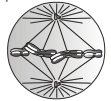
| 1. | Late prophase – chromosomes move to spindle equator |
| 2. | Metaphase – spindle fibres attached to kinetochores, centromeres split and chromatids separate |
| 3. | Metaphase – chromosomes moved to spindle equator chromosomes made up of two sister chromatids |
| 4. | Anaphase – centromeres split and chromatids separate and start moving away |
How many chromosomes will the cell have at G1, after S and after M phase respectively, if it has 14 chromosomes at interphase?
| 1. | 14, 14, 7 | 2. | 14, 14, 14 |
| 3. | 7, 7, 7 | 4. | 7, 14, 14 |
Colchicine is an inhibitory chemical, which
| 1. | Stops the functioning of centriole |
| 2. | Prevents attaching of centromeres with rays |
| 3. | Prevents the spindle formation in mitosis |
| 4. | Prevents the formation of equatorial plane |
A bacterium divides every 35 minutes. If a culture containing 105
cells per ml is grown for 175 minutes, what will be the cell concentration per ml after 175 minutes?
The term “Meiosis” was given by
| 1. | A. Flemming | 2. | Farmer and Moore |
| 3. | Johansen | 4. | Knoll and Ruska |
Crossing over that results in genetic recombination in higher organisms occurs between
(1) Sister chromatids of a bivalent
(2) Non-sister chromatids of a bivalent
(3) Two daughter nuclei
(4) Two different bivalents